German court to hear case brought by relatives of Yemen drone attack victims
photo
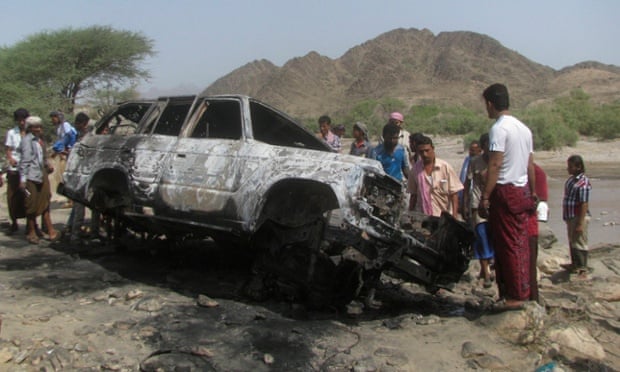
A German court is to hear a case against the government brought by relatives of victims of a US drone attack in Yemen in a groundbreaking action that has the potential to interrupt the American strikes.
The case of three Yemenis whose relatives were killed in the attack
in August 2012, will be heard on Wednesday by a court in Cologne.
Lawyers for the victims say the German government shares responsibility
for the death of civilians because the US military base of Ramstein, which allegedly played a key role in the attack, is on German soil. The government rejects the claim.
Faisal bin Ali Jaber, who lost his brother-in-law Salim, a preacher,
and his nephew Waleed, a police officer, in the strike on the village of
Khashamir on 29 August, 2012, is calling on Germany to accept legal and
political responsibility for the US drone war in Yemen and to ban the
use of Ramstein for such operations. In an interview with the Guardian in 2013 when he visited Washington to talk to White House officials, he pleaded for recognition of the deaths.
Ramstein, in the German state of Rheinland Pfalz, is used by the US
military on condition nothing is done there that violates German law.
The German government has been repeatedly accused of failing to confront
Washington over Ramstein’s alleged role in the drone war.
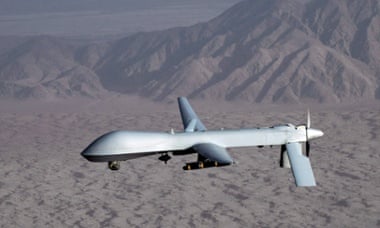
A US MQ-1 Predator unmanned aircraft in flight at an undisclosed location. Photograph
The case rests on the claim that Ramstein is central to the drone
strikes because it relays crucial information via satellite that enables
drone operators in Nevada to communicate with the aircraft in Yemen,
Pakistan, Afghanistan and elsewhere.
The geographical location of Ramstein is said to be vital to the
transmission of the information, because, due to the curvature of the
earth, a relay station is needed between the US and the Middle East.


No comments:
Post a Comment