EU referendum:Europe tells UK , Don't leave us this way
photo
David Cameron’s plan for a referendum on Britain’s membership of the European Union leaves the UK’s EU status more precarious that at any point for 40 years.
But what do continental powers feel about the possibility of Brexit –
a British EU exit? Five prominent writers from leading European
newspapers in France, Germany, Italy, Spain and Poland reflect the view from their country.
Germany
The German government is by now well used to the fact that the big questions of Europe will, sooner or later, end up in Angela Merkel’s in-tray.
Euro crisis, Grexit, Russia-Ukraine … Germany attracts these problems
like a magnet. That’s what you get when you’re the first among equals.
Not that the German authorities are always happy about it.
So it is that even on the subject of the British referendum, all eyes
are once again turning to Germany. Britain and the other EU members are
waiting for a signal: how ready is Berlin to meet David Cameron
halfway?
In these crunch moments, Merkel likes to do what she does best: she
waits it out. It’s not as if the Brexit alarm came out of the blue after
Cameron’s re-election. Over the past two years, no meeting between
Merkel and the British prime minister went by without the pair
discussing EU reform – and German resistance to it.
Merkel wants to keep Britain in the EU. She has made no secret of
this. She belongs to the German group of politicians that tend towards
anglophilia, not francophilia. She respects the British political
system, admires the system of parliamentary debate and values the
calmness with which the democratic system has always operated. Anyone
wanting to understand her sympathy for Britain need only read the speech
she made in February last year to both houses of parliament in which
she outlined all the reasons why Britain really belongs in the EU.
For Merkel it is essentially a question of the political heft and
power of the EU, which would be hugely damaged if not destroyed if such a
significant power as Britain were to withdraw. Her political message to
Cameron is: pull out, and your country will find its position in the
world reduced. But below the surface, she is equally worried about the
balance in Europe where Britain is often seen as a German ally in
matters that pit the north against the south.
Merkel cannot understand how through the last UK parliament Cameron
let himself be pushed into ever deeper commitments on Europe by the
anti-EU factions in his party, only to find that his opponents would
raise the bar still further. She admires Cameron as a speaker – but
certainly not as a tactician.
That could all change if the prime minister sticks to the rules of
the game which have been negotiated by Berlin and London over the past
six months. The most important of which is: keep your mouth shut while
you’re preparing reform, so as not to give your critics any ammunition.
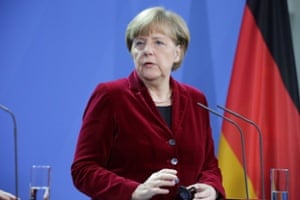
German chancellor, Angela Merkel. Photograph: Jakob Ratz/Corbis
The bottom line in all this is that the Germany government assumes
that the British prime minister also really wants to keep Britain in the
EU. And so the question arises: what is the price that Cameron believes
he must ask? Berlin has already made perfectly clear that any changes
to European treaties would be too risky. The crushing rejection of the
constitution in referenda in France
and the Netherlands taught Germany’s political class that the delicate
theme of Europe should never simply be put to a yes-no vote.
On the other hand, ever since the euro crisis, Merkel’s principal
goal is to immunise Europe’s economic union against further currency
shocks. To do that, treaties will probably have to be changed. And yet:
there is as yet no real appetite for a big reform project in Europe, and
in the middle of the Greek crisis it is more than improbable that the
other European nations are suddenly going to want to take on the next
big European project.
And so Merkel will try to reduce the British aims to digestible
chunks which she can then make appear palatable to the rest of Europe.
It’s clear she lends a sympathetic ear to many reformist ideas; in
London last year she said: “We must constantly renew Europe’s political
shape so that it keeps up with the times.”
Beyond the platitudes, Merkel is open to reforms to the internal
market, to competitiveness, to the bureaucracy and even to some of the
institutions.
Cameron’s central theme – freedom of movement, and above all economic
migration within the EU – will be the biggest problem. But even here,
Merkel and Cameron have made some provisions. Cameron’s big freedom of
movement speech last year was closely agreed with Berlin and was then
promptly praised by Merkel. Both are firmly agreed that there should be
no incentives for economic migrants, such as out-of-work benefits. But
Merkel will not agree to quotas or special rules for Britain on this.
Merkel will now repeat two messages in the coming months, which she
has borrowed from a 30-year-old speech by the late former president
Richard von Weizsäcker: Britain belongs to Europe, because without
Britain we would not have a democratic Europe. And Europe will only
evolve by degrees, not in leaps and bounds.
Merkel gets spooked by the radical – and that’s why this referendum
idea is an abomination. She would never stake all her political capital
on one small question. Stefan Kornelius, of Süddeutsche Zeitung in Munich
Italy
The last time London broke away from Europe it was because of a fight
with Rome. Henry VIII wanted to marry Anne Boleyn so broke off
relations with the Pope, who opposed it. Just like today, many advisers
of the king were worried, but for England in the 16th century, it was a
happy choice: it discovered that there were more dynamic countries with
which it could do business, and lay the foundation of its empire.
Relations with Rome are now decidedly better. As British ambassador
Christopher Prentice said, in very British way: “It’s not just bread and
butter, but also jam.” Until just a few years ago, an Italian in London
was invariably greeted by giggles and jokes about “bunga-bunga”, but
since Mario Monti has been in government, we’ve been considered rather
more serious and reliable by Downing Street and in the City (thus
creating the widespread impression that things can even get better if
Italians do not actually vote for who governs them).
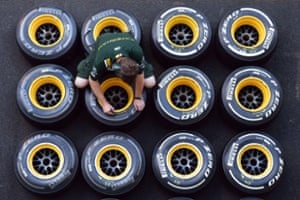
A Lotus F1 team mechanic marks wheels with Pirelli tyres. Dozens of
Italian firms are established in the UK. Photograph: Vincenzo
Pinto/AFP/Getty Images
Business relations are optimal and dozens of Italian companies, from
Finmeccanica to Eni, from Merloni to Calzedonia, from Pirelli to
Ferrero, are well established in Britain. The British want from us what
they believe we do well: clothing, food, sports cars, furniture,
domestic appliances, and beer (yes, even that), and collaboration with Italy
in the fields of energy, defence and aerospace research. We import
drugs, cars, hi-tech, whisky, financial services and technology for
renewable energy from them. If Britain leaves Europe, all of the rules
that made this possible and mutually convenient would have to be
revisited – and what happens then would depend on new rules, and
especially new tariffs.
The separation would not be painless. There are maybe 200,000
Italians living in Britain, about half of them in London. If, as
expected, Brexit causes the loss of many jobs (the optimists predict one
million, the pessimists three), tens of thousands of Italians will
return home. Those who remain will have to apply for a residence permit
and work permit, and the same will have to be done by 20,000 British
people living in Italy. London won’t be the destination of choice
anymore for young people with two degrees who are looking for a job at
Caffè Nero to pay for a master’s degree: they will face queues at
passport control and have to undergo a bureaucratic rigmarole similar to
the one that exists in the United States.
The link between Italy and Great Britain will not die easily. The
bread and butter is business, but the jam is made of a true mutual love,
which began centuries ago with the Roman travels of Browning and
Shelley, and Byron and Keats, who were staying in hotels that were
called de Londres and de l’Angleterre, Brighton and Victoria. It was
their ecstatic stories that convinced everyone that you could not become
a true gentleman without having visited Rome.
The British are now more in love with Italy than the Italians are:
they appreciate the food, the language, the tastes, the gestures of the
people, the Tuscan landscape, the climate that renders indolence a
little bit inevitable. It’s a love that is reciprocated: the Italians
adore London, they colonised South Kensington and Chelsea when Russian
oligarchs were still putting aside their first roubles; they have
learned English manners; they look to Prince Charles to understand male
elegance; and they are grateful to have got their slice of the Beatles,
David Beckham, James Bond and royal gossip. Even if politics divide
them, Italy and Great Britain will never leave one another. Vittorio Sabadin, of La Stampa in Turin
France
François Hollande wasted no time in congratulating David Cameron on
his re-election this month, inviting him to a prompt tête-à-tête in
Paris – but a British referendum on leaving Europe raises a number of
reservations in France.
Only a few isolated voices – such as former cabinet ministers Laurent
Wauquiez and Michel Rocard – argue in favour of a Brexit, the latter
considering that Britain is principally to blame for the paralysis in
European decision-making.
Officially, French leaders intone how they want to see London stay in
the European club, but not at the expense of giving away lots of
concessions to help Cameron. They insist there can be no question of
opening up European treaties for reform, as Cameron demands, nor of any
fundamental change to EU migration rules – Ukip’s main hobby horse. “The
functioning of the European Union can be improved, but we cannot go
back on its founding principles,” France’s secretary of state for
European affairs , Harlem Désir, warned shortly after Cameron’s
re-election. “One country alone cannot call into question the desire of
the others to continue to advance together.”
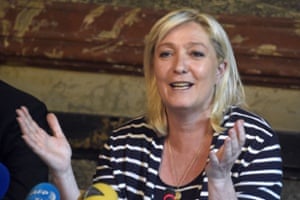
Front National party president, Marine Le Pen. Photograph: Dominique Faget/AFP/Getty Images
Seen from Paris, the debates on Britain’s EU membership, and
certainly a British exit following Cameron’s promised referendum, risk
having a knock-on effect on French public opinion: a Brexit, if it
actually happened, could hardly fail to encourage France’s
sovereigntists or the far right. Marine Le Pen is already demanding that
France leave the euro, or that the Schengen free circulation area be
suspended.
This preoccupation is all stronger because Cameron initially promised
to hold his referendum in 2017, a difficult time for the French
government because of presidential and parliamentary elections that
year. The prime minister’s entourage is now mulling a vote before the
end of 2016. “It would be better if this uncertainty did not go on too
long,” a senior French official commented, “but whatever happens that
would not leave time to start a process of treaty reform.”
In the meantime, what French officials fear most is an alliance
between Cameron and Angela Merkel, the German chancellor, who is intent
on keeping Britain on board the European boat. The chancellor has often,
along with her finance minister Wolfgang Schäuble, flirted with the
idea of European treaty reform to consolidate monetary union – something
the British rarely fail to mention when they demand (despite having
refused to join the euro) such a debate, with a view to obtaining new
exemptions from EU standards.
Facing what they consider contradictory pressures on two fronts, the
French government plays them off against each other: the repatriation of
powers from Brussels to national governments (as sought by Cameron) and
increased integration – particularly budgetary integration of which the
Germans dream in order to consolidate the eurozone – are, for France,
“incompatible”. It would be better all round, Paris reckons, not to
disturb Europe’s present fragile equilibrium by opening Pandora’s box.
A new reform of the European treaties would be highly likely to fuel
an intense public debate in France, perhaps even to be rejected if it
were also put to a referendum. Ten years after France’s “non” to the
European constitution, on 29 May 2005, François Hollande, who was then
leader of the French Socialist party, still harbours memories of the
stinging defeat of the “oui” for which he had campaigned against the
advice of a sizeable chunk of his party. An unpleasant experience of
which he will doubtless remind Cameron in the months to come. Philippe Ricard, of Le Monde in Paris
Spain
It’s difficult to think of two countries whose paths into the EU could have been as different as those of Spain and the United Kingdom.
In Spain’s case, our adherence to what was then the European
Community was the culmination of a yearning by successive generations
cut off from the possibility of joining the broader current of peace,
democracy and progress that was flowing north of the Pyrenean border.
Hence the intense, proud and enthusiastic process of Europeanisation
on which Spanish society, its politicians, businesses, intellectuals and
unions embarked, first in 1978 with the adoption of the constitution,
and then from 1986 with the formalisation of European accession.
A pro-EU demonstration in Madrid. Photograph: Javier Soriano/AFP/Getty Images
In the UK, on the other hand, finally joining the EU was not a
historic achievement around which to build a story of national pride but
a double defeat: firstly, that of an empire saying goodbye to its
territories overseas, and secondly, a failure to organise European
affairs around a rival model launched by the Treaty of Rome in
association with the European Free Trade Association (EFTA).
All of which explains how, from countries such as Spain, it’s not
easy to understand why the desire to be members of the EU – something
which to us is so simple and intuitive, even despite the recent crisis
and the implementation of tough austerity policies and agreements – can
cause so many complications for the British.
This incomprehension does not necessarily mean that Spain would
represent an obstacle for David Cameron as he negotiates a better
agreement with the EU. Unlike in other European capitals, where one can
perceive a degree of animosity and frustration with Cameron’s tricks and
tactics, Spain has no special interest in making things hard for the
British prime minister.
That’s not to say, however, that he will have it easy. In Madrid, as
in other capitals, there will be a certain flexibility to negotiate the
exceptions that may eventually accommodate the UK. The British are
specialists at this and the rest are already used to it, so technically
there is no reason why it should be difficult to come to an agreement.
Spain, however, is not simply going to accept Britain’s desire to
force all of its partners to negotiate a treaty which requires
parliamentary ratification or referendums across the member states. That
would open a public opinion can of worms which, over the past decade,
has taken so much to close.
Spain also has no sympathy with the idea of distorting the
fundamental principles, such as free movement of people, until they
become unrecognisable, purely so as to give ammunition to Cameron again
the xenophobic Ukip.
So in the coming months, Cameron will try to convince his European
partners that the British are willing to leave if their demands are not
met. Meanwhile, they will try to convince him that they can’t give him
what he’s asking for.
The question is, who will British voters believe in when the moment
of truth arrives? Cameron, who will say that he has won a historic
agreement, or the European leaders, who will say that they haven’t given
him anything important? José Ignacio-Torreblanca, for El País in Madrid
Poland
Have the British gone mad? That was the Polish reaction to the news
that David Cameron intended to call a referendum on his country’s future
membership of the European Union.
To Polish ears, the notion sounded like blasphemy. Poles are the
biggest enthusiasts in Europe. And among the new members, they are the
champions at spending money from structural funds.
We spend every cent the EU gives. And thanks to that, in the course
of 10 years of membership, our country has changed out of all
recognition. We have motorways, fast trains, airports, schools,
libraries and swimming pools.
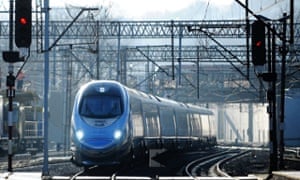
A high-speed Pendolino train in Gdańsk, Poland. Photograph: Rex/Shutterstock
(Still, at the beginning of the 21st century, a leading European
economic magazine doggedly insisted on illustrating a piece about Poland with a peasant riding on a cart. Today, carts are to be seen in museums.)
Polish farmers, who before accession were tearing their shirts and
warning that the evil Germans and French would buy up Polish land for
nothing, are emerging as the biggest beneficiaries of the EU. Of course,
they still complain about their fate, but at home they have plasma
televisions, and they drive out on their fields on tractors worth tens
of thousands of euros.
How, then, can you quibble with such a union? It would be biting the
hand that feeds you so generously. Brexit fans in the British Isles will
find few allies on the Polish political scene.
In the Polish debate, the issue of the Brussels diktat or loss of
sovereignty has surfaced only very rarely of late. Britain’s dilemma
over whether to stay in the EU is not a subject that newspapers write
about every day in Poland. But we fear some evil spirit might take hold
of the British, and that in the referendum they will say “bye” to the
EU.
Our history is full of bad decisions that led to dramatic changes.
With that in mind, Polish experts say that the impact of Brexit would be
felt equally in Britain and in the EU. And as goes the EU, so go we.
It is not just an economic question. Without Britain, European unity
will be weaker. And beyond our eastern border, Vladimir Putin is
calculating his next move after the Crimean Anschluss and setting fire
to eastern Ukraine. A European Union weakened by Brexit might encourage
him to light another blaze in our neighbourhood.



No comments:
Post a Comment